
Evolution of Cricket Rules Over Time
Cricket is one of the oldest sports in the world, with a history spanning several centuries. What began as a simple bat-and-ball game in rural England has evolved into a global sport played and followed by millions across continents. The transformation of cricket has not only been driven by its growing popularity but also by continuous changes in rules, formats, and technology.
From the introduction of the first Laws of Cricket in the 18th century to modern innovations such as the Decision Review System (DRS) and T20 cricket, the game has constantly adapted to changing times. Understanding the evolution of cricket rules provides valuable insight into how the sport became the international phenomenon it is today.
The Origins of Cricket and Early Rule Development
Cricket is believed to have originated in southeastern England during the medieval period. According to the International Cricket Council (ICC), the game was initially played by children before gradually becoming a popular adult sport in the 17th century.
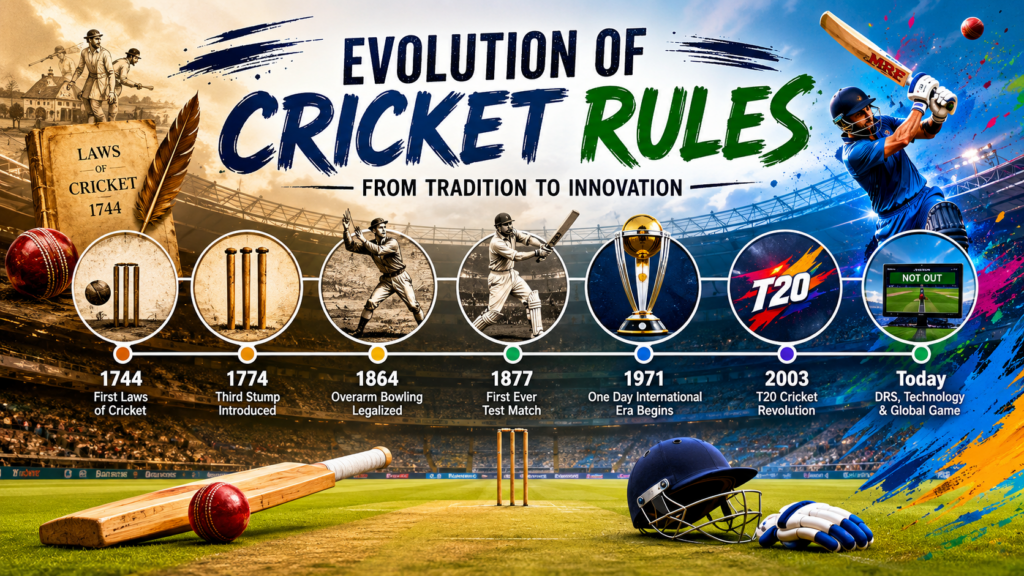
As cricket gained popularity, the need for standardized rules became evident. In 1744, the first official Laws of Cricket were written. These laws established key aspects of the game, including:
- Pitch dimensions
- Methods of dismissal
- The role of umpires
- Basic match regulations
This milestone laid the foundation for organized cricket and helped create consistency across matches.
The Introduction of the Third Stump and LBW Rule
One of the earliest major rule changes occurred in 1774 when the third stump was added to the wicket. Before this change, batsmen often escaped dismissal because the two-stump wicket left a larger gap.
The same period also saw the introduction of the Leg Before Wicket (LBW) rule, designed to prevent batsmen from using their legs to block the ball unfairly. These changes significantly improved the balance between batting and bowling.
Evolution of Bowling Styles
Early cricket featured underarm bowling, where the ball was rolled or skimmed along the ground. However, as bowlers sought greater effectiveness, they began pitching the ball.
This innovation led to a major transformation in cricket. The traditional curved bat gradually evolved into the straight bat used today, allowing batsmen to handle bouncing deliveries more effectively.
Another landmark change arrived in 1864 when overarm bowling was officially legalized. This revolutionized the sport by increasing pace, movement, and strategic depth.
Expansion of Cricket Across the World
During the 18th and 19th centuries, cricket spread through the British Empire. The game reached:
- India
- Australia
- South Africa
- New Zealand
- The West Indies
The establishment of county clubs and international competitions helped standardize playing conditions and rules worldwide.
A significant moment came in 1909 with the formation of the Imperial Cricket Conference, now known as the International Cricket Council (ICC). The ICC became responsible for governing international cricket and maintaining consistency in the Laws of the game.
The Birth of Test Cricket
The first officially recognized Test match was played between Australia and England in 1877. Test cricket introduced a long-format structure that emphasized patience, skill, endurance, and strategy.
For decades, Test cricket remained the ultimate form of the game. However, as audiences sought faster entertainment, new formats emerged.
The Rise of One Day International (ODI) Cricket
A major turning point occurred in 1971 when the first One Day International (ODI) was played between Australia and England.
Unlike Test matches, ODIs limited each team to a fixed number of overs, making games shorter and more accessible for spectators. The success of the format led to the first Cricket World Cup in 1975.
ODI cricket introduced several innovations, including:
- Colored clothing
- White balls
- Day-night matches
- Fielding restrictions
These changes enhanced both viewer engagement and commercial appeal.
The T20 Revolution
The biggest transformation in modern cricket came with the introduction of Twenty20 (T20) cricket in 2003.
Designed as a fast-paced format lasting approximately three hours, T20 cricket attracted new audiences and expanded cricket’s global reach. The format encouraged aggressive batting, athletic fielding, and innovative bowling strategies.
The popularity of tournaments such as the Indian Premier League (IPL) further accelerated the growth of T20 cricket and changed the financial landscape of the sport.
Technology and Modern Rule Changes
Modern cricket has embraced technology to improve fairness and accuracy.
Decision Review System (DRS)
Introduced in the 21st century, DRS allows teams to challenge umpiring decisions using technology such as:
- Ball tracking
- UltraEdge
- Hawk-Eye
- Hot Spot
This innovation has significantly reduced human error in critical decisions.
Powerplays and Fielding Restrictions
Limited-overs cricket introduced powerplays and fielding restrictions to create a better balance between bat and ball while encouraging attacking cricket.
Player Safety Regulations
Cricket has also evolved to prioritize player safety. Modern rules require protective equipment such as helmets and include stricter regulations regarding dangerous bowling and concussion substitutes.
Women’s Cricket and Greater Inclusivity
Another important development in cricket’s evolution is the growth of women’s cricket.
As the sport expanded globally, governing bodies worked to provide equal opportunities for female cricketers. Today, women’s cricket enjoys increased visibility, professional contracts, and major international tournaments.
The introduction of Women’s T20 Internationals and global events has played a crucial role in the sport’s development.
The Spirit of Cricket
While rules have evolved significantly, cricket continues to uphold its traditional values through the “Spirit of Cricket.”
This concept emphasizes:
- Respect for opponents
- Fair play
- Sportsmanship
- Respect for officials
The Spirit of Cricket remains one of the unique characteristics that distinguishes the game from many other sports.
FAQs
When were the first official Laws of Cricket written?
The first official Laws of Cricket were written in 1744, providing a standardized framework for the game.
When was overarm bowling legalized?
Overarm bowling became legal in 1864, transforming bowling techniques and increasing competition between bat and ball.
What was the first international cricket format?
Test cricket was the first official international format, with the inaugural Test match played in 1877 between Australia and England.
When did ODI cricket begin?
One Day International cricket started in 1971, offering a shorter and more spectator-friendly format.
Why is T20 cricket so popular?
T20 cricket is popular because of its fast-paced action, shorter duration, high scoring, and entertainment value.
Final Thoughts
The evolution of cricket rules reflects the sport’s remarkable ability to adapt while preserving its rich traditions. From the codification of the Laws of Cricket in 1744 to the introduction of T20 cricket and advanced technology like DRS, every change has shaped the modern game. Today, cricket successfully balances heritage, innovation, and global appeal, ensuring its continued growth for future generations. As new technologies and formats emerge, cricket will undoubtedly continue evolving while maintaining the spirit that has defined it for centuries.