
Most Dominant Women’s Cricket Eras Compared
Women’s cricket has evolved dramatically over the last few decades, moving from limited international exposure to a globally celebrated sport with professional leagues, packed stadiums, and elite athletic performances. Each era of women’s cricket brought its own dominance style—whether it was Australia’s early supremacy, England’s structured rebuild, or the modern franchise-driven global competition.
In this article, we break down the most dominant women’s cricket eras, compare their impact, and understand how the game has transformed into what it is today.
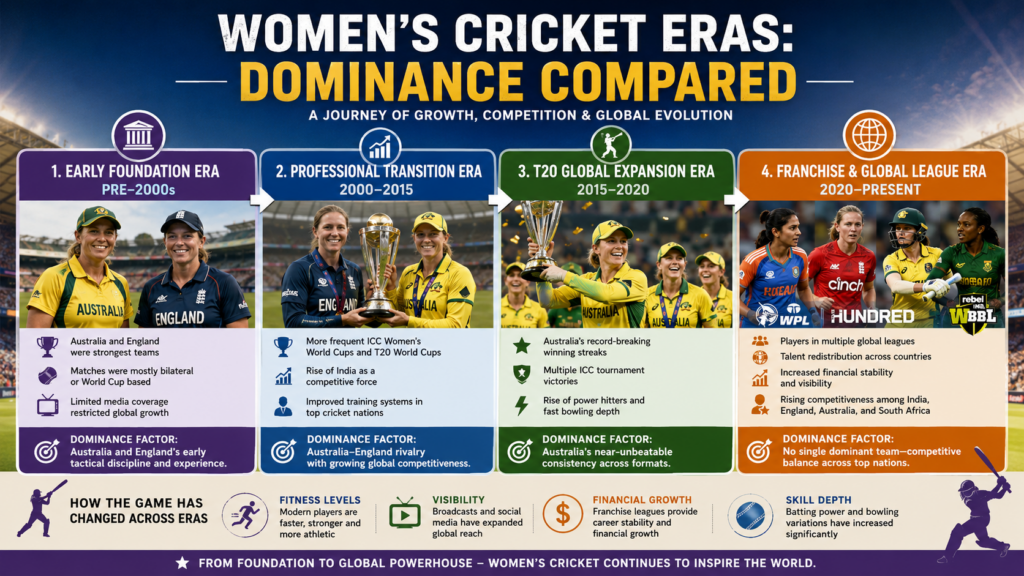
1. Early Foundation Era (Pre-2000s): Building the Base
The early phase of women’s cricket was defined more by passion than professionalism. International matches were limited, resources were scarce, and most players balanced careers alongside cricket.
During this era:
- Australia and England were the strongest teams
- Matches were mostly bilateral or World Cup based
- Limited media coverage restricted global growth
The first major turning point was the ICC Women’s Cricket World Cup, which helped structure international competition. According to historical insights from Lord’s Cricket Ground, this era laid the foundation for structured global tournaments and long-term development of the women’s game.
Lord’s Cricket – Women’s Cricket Evolution
Dominance factor: Australia and England’s early tactical discipline and experience.
2. Professional Transition Era (2000–2015): Rise of Competitive Balance
This period marked the beginning of serious investment and structured international competition. The introduction of ICC governance improvements and expanded fixtures helped elevate the standard of play.
Key highlights:
- More frequent ICC Women’s World Cups and T20 World Cups
- Rise of India as a competitive force
- Improved training systems in top cricket nations
England’s 2009 World Cup and T20 World Cup double win signaled a shift in dominance. Meanwhile, Australia remained consistent, creating a rivalry that shaped modern women’s cricket.
As noted in analysis of Ashes eras, this phase also intensified historic rivalries like the Women’s Ashes, which became a benchmark of elite performance comparison.
Cricket Australia – Women’s Ashes Eras
Dominance factor: Australia–England rivalry with growing global competitiveness.
3. T20 Global Expansion Era (2015–2020): Australia’s Golden Command
This era is widely considered one of the most dominant phases in women’s cricket history, largely controlled by Australia.
What defined this era:
- Australia’s record-breaking winning streaks
- Multiple ICC tournament victories
- Rise of power hitters and fast bowling depth
Players like Meg Lanning, Ellyse Perry, and Alyssa Healy defined consistency and dominance. Australia’s approach combined fitness, depth, and tactical intelligence unmatched by other teams.
At the same time, the T20 format became central to the sport, creating a faster, more viewer-friendly version of cricket that attracted global audiences.
Dominance factor: Australia’s near-unbeatable consistency across formats.
4. Franchise & Global League Era (2020–Present): Competitive Global Parity
The current era is the most dynamic and commercially influential phase in women’s cricket history. The introduction of franchise leagues like the Women’s Premier League (WPL), The Hundred, and expanded WBBL has completely changed the ecosystem.
Key features:
- Players participating in multiple global leagues
- Talent redistribution across countries
- Increased financial stability and visibility
- Rising competitiveness among India, England, Australia, and South Africa
This era has reduced long-term dominance by a single nation. Instead, power shifts frequently depending on formats and conditions.
Modern coverage of women’s leagues shows how global tournaments are now central to player development and fan engagement.
Women’s Cricket Leagues Around the World
Dominance factor: No single dominant team—competitive balance across top nations.
Comparison of Women’s Cricket Eras
| Era | Time Period | Dominant Team | Key Feature |
| Foundation Era | Pre-2000 | Australia & England | Building structure |
| Transition Era | 2000–2015 | England (brief), Australia | Growing competitiveness |
| T20 Expansion Era | 2015–2020 | Australia | Tactical dominance |
| Franchise Era | 2020–Present | Balanced | Global competitiveness |
How the Game Has Changed Across Eras
Women’s cricket evolution is not just about winners—it’s about transformation:
- Fitness levels: Modern players are faster, stronger, and more athletic
- Visibility: Broadcasts and social media have expanded global reach
- Financial growth: Franchise leagues provide career stability
- Skill depth: Batting power and bowling variations have increased significantly
Earlier eras relied heavily on technique and experience, while modern cricket blends athleticism, analytics, and adaptability.
FAQs
1. Which is the most dominant era in women’s cricket?
The 2015–2020 period is often considered the most dominant due to Australia’s unmatched winning streak and ICC success.
2. How has women’s cricket changed in recent years?
It has become more professional with franchise leagues, better pay structures, and global participation.
3. Which teams have dominated women’s cricket historically?
Australia and England have historically been the most dominant teams, with India emerging strongly in the modern era.
4. What role do franchise leagues play today?
Leagues like WPL and WBBL help develop young talent, improve skills, and increase global visibility.
Final Thought
Women’s cricket has moved from a developing sport to a globally competitive powerhouse in just a few decades. Each era contributed something unique—foundation building, competitive rivalry, Australian dominance, and now global balance through franchise leagues.
Today, instead of one dominant team, women’s cricket is defined by constant competition and rapid evolution, making it one of the fastest-growing sports in the world. As the next generation of players continues to rise, the future promises even more exciting shifts in dominance and performance